The Hidden Story Beneath Plitvice’s Deepest Waters: Lake Kozjak Revealed
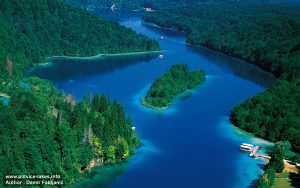
At the heart of Plitvice Lakes National Park lies Lake Kozjak, the largest and deepest lake in the park. Covering an impressive 82 hectares and reaching depths of up to 47 metres, Kozjak has always captivated visitors with its vast, dark-blue surface. It forms the natural boundary between the Upper and Lower Lakes and marks the meeting point of two distinct geological periods — Triassic dolomites and Cretaceous limestone. Yet the real mystery of Kozjak lies beneath its calm waters. Hidden below the surface is silent evidence of dramatic natural changes that occurred around four centuries ago.
Two Lakes That Became One
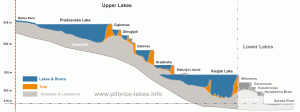
Until about 400 years ago, the area of today’s Lake Kozjak was not a single body of water. Instead, it consisted of two separate lakes, divided by a massive tufa barrier. (see diagram)This natural barrier stretched roughly 400 metres wide and stood 36 metres high.
Today, that once-mighty formation rests submerged approximately six metres below the lake’s surface. On bright, sunny days, passengers aboard the park’s panoramic electric boats can sometimes glimpse it as a pale, whitish line deep beneath the water.
It raises a fascinating question: how did a barrier over which powerful waterfalls once cascaded end up lying at the bottom of the lake?
Old Theories and New Discoveries
For decades, the prevailing theory — dating back to the mid-20th century — suggested that the downstream barrier, known as the Kozjak Bridges, grew more rapidly than the upstream one. According to this explanation, water levels gradually rose until they eventually submerged the upper barrier, trapping it beneath the expanding lake.
Similar processes can be observed in other parts of the park, such as at Lake Milanovac or Lake Prošćansko. However, new research conducted in autumn 2019 offered a completely different explanation — one that reshaped understanding of Plitvice’s hydrological history.
Popular Routes: Zagreb to Plitvice, Zadar to Plitvice, Split to Plitvice
The Moment the Barrier Broke
Modern underwater investigations by divers revealed what appears to be the precise location where part of the barrier likely mechanically fractured, creating a channel about four metres deep. This rupture allowed the waters of the two lakes to merge, forming the single, expansive Lake Kozjak we see today.
Although such breakages are not everyday occurrences, they are not unusual either. Tufa — the porous limestone material that forms Plitvice’s famous barriers — is delicate and constantly evolving. It can be damaged by extreme weather, sudden temperature changes, or significant water-level fluctuations caused by rapid snowmelt.
The merging of the two lakes was therefore not a slow, gentle process but likely the result of a sudden structural collapse — a powerful reminder of nature’s unpredictability.
A Living, Changing Landscape
More recent examples of tufa breakage within the park confirm that such events can dramatically alter the landscape in a relatively short time. Yet these changes are not disasters — they are part of a natural cycle of growth, erosion, and renewal.
The tufa barriers at Plitvice are not static monuments; they are living structures, continuously forming, reshaping, and sometimes breaking apart. The submerged barrier beneath Lake Kozjak stands as a reminder that this UNESCO-protected landscape is dynamic and ever-changing.
For visitors standing on the shores of Kozjak or gliding across its tranquil waters, it may be hard to imagine the powerful forces at work beneath the surface. But the lake’s hidden story tells us that water is both a sculptor and a transformer — shaping the landscape over centuries and leaving behind remarkable traces of its strength.
Lake Kozjak is more than just the largest lake in Plitvice. It is a silent witness to centuries of geological evolution — a place where history rests quietly beneath dark blue depths, waiting to be discovered.


